
Black History
In The Making 2024:
Mark Watson
In The Making 2024:
Mark Watson
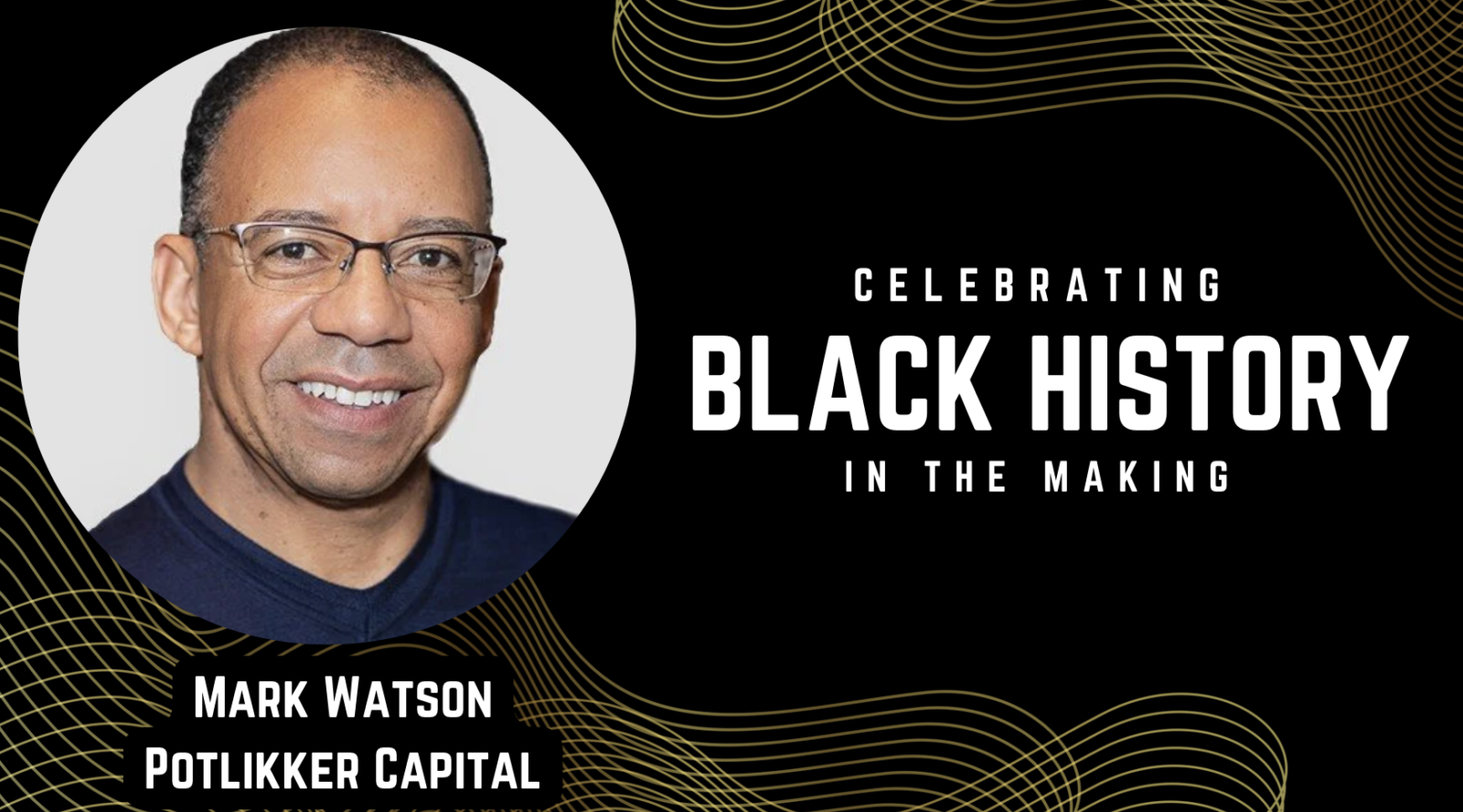
Black History Month presents an opportunity to remember the Black icons who have paved the way for us in every realm and industry. While acknowledging the contributions of leaders past, this year, we would like to give a nod to those who walk among us now. We sat down with four Black changemakers, who are using their skills and spheres of influence to extend the ladder, and lifting us all up with them.
Our third interview was with Mark Watson. Mr. Watson is the President of Potlikker Capital, a nonprofit charitable loan fund and integrated capital fund supporting BIPOC farmers at the intersection of racial and climate justice. He started his career as a banker at the First National Bank of Chicago, then JP Morgan. Mark has had a 30-year career managing investment portfolios for foundations, endowments, and institutional pension funds. Mark was formerly the Managing Director and served as a Senior Investment Strategist of the Fair Food Fund, and Managing Director of The Boston Impact Fund. Mark holds a Bachelor of Science in Finance from the University of Illinois Urbana-Champaign, and a Master’s in Business Administration from the Booth School at the University of Chicago. Below is an excerpt from the interview.
Please tell us about your organization.
Potlikker Capital is a nonprofit charitable loan fund, which is a lot of words, but we essentially provide knowledge, as well as financial and social capital, to farmers of color nationally who are willing to farm, produce, and distribute at the intersection of what we call racial justice, social justice, and climate justice. All of our communities of color have very different histories and probably different futures, and we try to be sensitive to that.
The biggest goal is to preserve voice in our agricultural policy, preserve food sovereignty in our communities, and to build resilience to have all of our partners be able to deal with climate and economic and social shocks.
Amazing. That’s very necessary work. How did you get started in the food and agriculture space?
It really, to be frank with you, was circumstantial. Twenty-five years ago, I used to work on Wall Street. I worked in banking. I managed pension money for states, companies and individuals, and I made a decision when I saw how resources were being allocated. I needed to take the talents my family and ancestors gave me and use them to redirect that capital to my community and other communities that don’t get a chance. I made that decision in my late thirties, early forties that I would do that the rest of my life. So, I have subsequently spent the last 25 years building initiatives, intermediaries, and programs that all address it in that way. The boards that I’m on are all about that.
And so, this is a key thing. One of the boards that I was asked to join was a fair food investment fund. I was one of their early board members, and it (the board) was making investments in food entrepreneurs, using blended capital, grants, loans, equity, etc., at low prices. I got an invitation to help build an intermediary called the Boston Impact Initiative Fund, and together with the person who founded it, I used the skills that I had in banking and finance to build a structural entity that could fund entrepreneurs of color in a place so that they could have a relationship with themselves and the community to buttress their businesses.
What words of wisdom do you have for folks trying to make the food space more equitable, and how do you bestow that wisdom on to others?
I guess my wisdom is this, and it took me some time to learn, but once you decide to take hold of your own destiny, that’s one decision. There’s a second or series of decisions that people have to make, and that’s around deconstructing what they know so that they are not continuing the harm. Oftentimes, we think we know. But we know what we’ve been taught or what we’ve been exposed to, and that may not be what’s appropriate for the future. That’s why I created Potlikker, working at the intersection of social and climate justice.
In celebration of Black History Month, is there something in particular about our culture that has inspired you?
One example or place that evokes the feeling I carry with me is the Legacy Museum in Montgomery, Alabama. It is one of the best exhibits that connects all Black people. I don’t mean just African-Americans, but all that Black people, particularly African-Americans, have sustained, and yet we are still here. It starts with a giant wall looking from the African continent, and it ends with mass incarceration. It connects every major challenge and every major success, and the ways we worked around to survive. It is amazing. You just come out of there heavy but also in amazement of how our people survived.
Black History Month is about survival, self-knowledge and self-validation. As people, continually, we are challenged. Our worth (and) our contributions are told to be limited, and yet we rise like the foam. Now I’m older and I see and understand that there will be more challenges, but like diamonds that are born under pressure.