
Black History
In The Making 2024:
Konda Mason
In The Making 2024:
Konda Mason
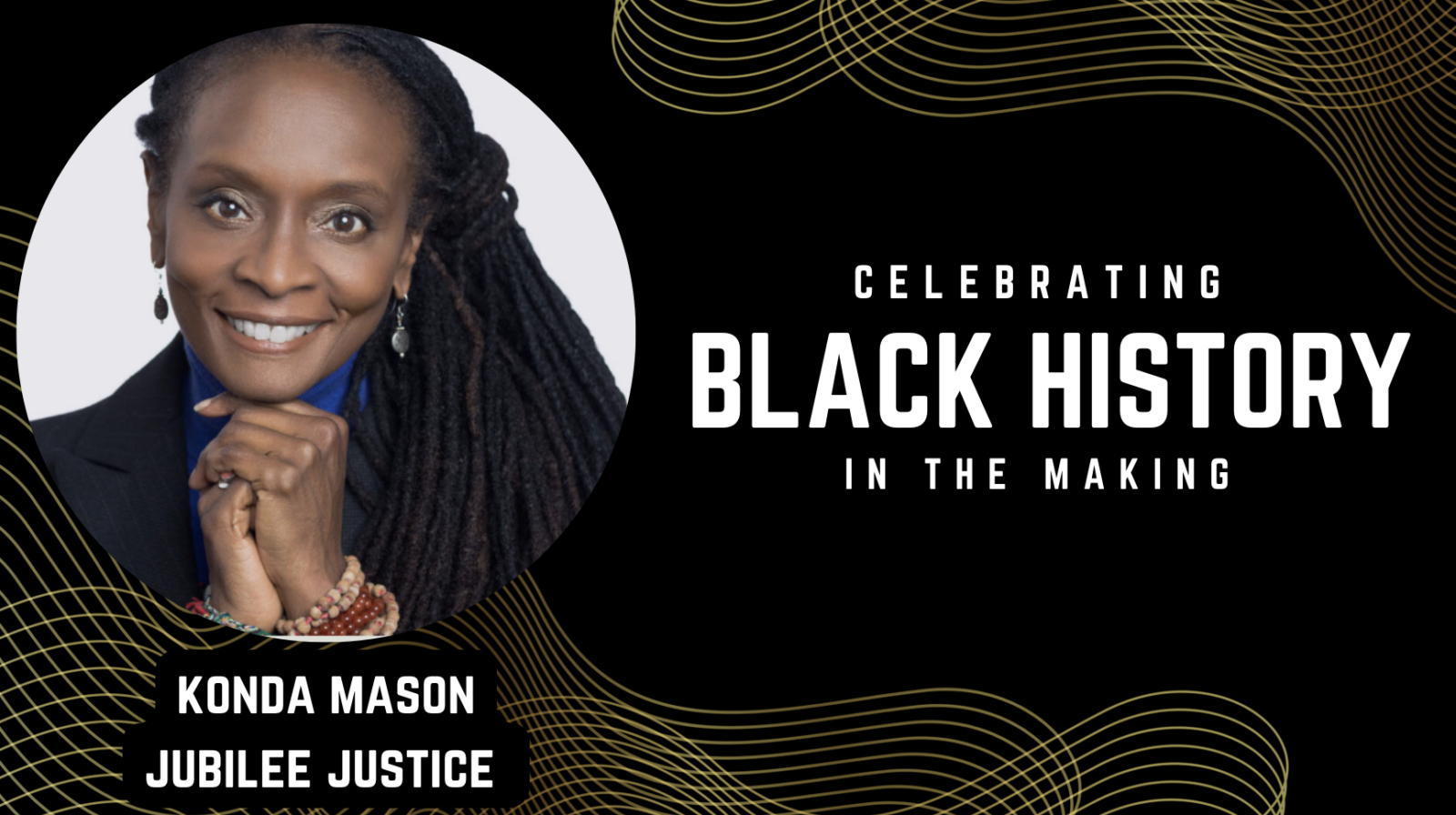
Black History Month presents an opportunity to remember the Black icons who have paved the way for us in every realm and industry. While acknowledging the contributions of leaders past, this year, we would like to give a nod to those who walk among us now. We sat down with four Black changemakers, who are using their skills and spheres of influence to extend the ladder, and lifting us all up with them.
Our second interview was with Konda Mason. Ms. Mason is the Founder and President of Jubilee Justice, Inc., a nonprofit working to bring climate-resilient farming and economic equity to Black farmers in the rural South. She is focused on restoring and accelerating Black land ownership and stewardship, and creating thriving Black farming communities. She is also an entrepreneur, social justice activist, and mindfulness teacher. Below is an excerpt from the interview.
What words of wisdom do you have for folks who want to make the food system more equitable? How do they replicate what you have done in transitioning from urban culture into agriculture?
I’m a person, in general, that has been led by the spirit within me, the ancestors within me, and I have always, always, always listened and taken the path that took me, wherever that took me, without worrying about the stuff that people worry about. Like, “How am I going to make money?” “How am I going to do this or that?.” I don’t worry about that because I have so much faith. I’ve had my ups and downs like anybody else, but I emerged. I’ve had a really good life. I’ve been able to take advantage of that voice that tells me what to do and I am not unique. Everybody has that, but we have pretty much washed it and don’t believe in it.
People need to give themselves permission to really pay attention because it’s there and wherever that craving is that gets overridden by the mind, I think people should learn a way to allow it in and find a pathway. Everybody’s got their own pathway and you don’t have to do everything all at once, but finding your pathway is really, really important. It’s really just listening, and not overriding it and saying, “Okay.” Saying yes. It’ll reveal itself. Fear stops everything. Fear is the biggest culprit. We live with so much fear. Fear of what’s going on inside ourselves, fear of the other. Fear of everything. And looking at fear in ourselves and how it stops us from so many things is a really good practice.
Black folks often turn trauma into triumph. What has that looked like for you?
I grew up at a great time, a hard time in the history of this country. The murder of Dr. King, of Kennedy, all that was the year that I was in going into sixth, seventh grade. I grew up in a household that was very loving and political. My family was very much a part of the Civil Rights Movement and I was taught a lot by my family. Those events and everything that was happening then launched me.
On top of that, there was also a deep spiritual presence going on in the house with my mother. She came from Texas, and she had all kinds of other ways of being. So, her spirit was always a big piece of it for me. So I feel like the backdrop of the Civil Rights Movement, Black students, and the movement for Black studies. My brother was at Cal Berkeley in ’69. And I was there in high school. I was there every holiday, every chance I got, and all summer… As soon as I graduated, I went straight to Berkeley, and I was there during all of that. I became politicized and the movement that was happening to free the people. The Berkeley People’s Park with Sly and the Family Stone playing was incredible. Incredible. So, I am just blessed. I just really grew up at such a great time. As hard as it was…it was filled with so much. From the free state movement to the flower power movement, all that stuff in San Francisco and Berkeley. You know, that was the age where everybody thought that they could really change the world. And so, you acted like you could change the world.
What are some of your thoughts about regenerative agriculture?
It has to be the way that we go. Big Ag has also just destroyed the very earth upon which all life depends. All life depends upon soil, and as the soil goes, so does humanity. In regenerative ag, it’s just regenerating that which was before and it’s regenerating the soil. The role that ag plays, first of all, in climate, is absolutely huge.
I’m working right at the intersection of social justice and climate – which is all the same anyway to me – but we are growing rice. It’s the second largest emitter of methane in ag. There are so many millions of acres of rice growing all over the world, like South America, Africa, and Asia. And the amount of methane that is being emitted on the flooded fields is a huge contributor to climate change and global warming. We’re doing SRIs (System of Rice Intensification), which eliminates at least 50% of that water. It’s an intentional thing to teach Black farmers about it so that we get the Black farmers an innovative way of growing rice and hitting both the need of Black farmers to economically be able to be lifted up, and for us to be climate stewards of this planet. We’re also growing it regeneratively, which means we’re paying attention to a lot of the principles. Keeping the ground covered as much as possible, so we have cover crops rotation. Disturbing the earth as little as possible with low till, no-till, because without that, we have released the carbon that is supposed to be in the soil into the atmosphere and we are creating just disastrous results.
All the beneficial microbes that are the same as the microbes found in your gut that make everything work inside your belly as you eat, that’s what’s underneath the soil. They’re often destroyed because of the usual farming practices and you end up with soil that is depleted of any nutrient value and then we have food that is depleted of any nutrient value, and we only eat that. Regenerative agriculture is a part of this whole food system… We’re talking about food being at the core, and it involves soil. It involves regenerative agriculture principles… a lot of which came from black folks and indigenous people… Folks are now wrapping their heads around (the principles) and calling it regenerative ag.